


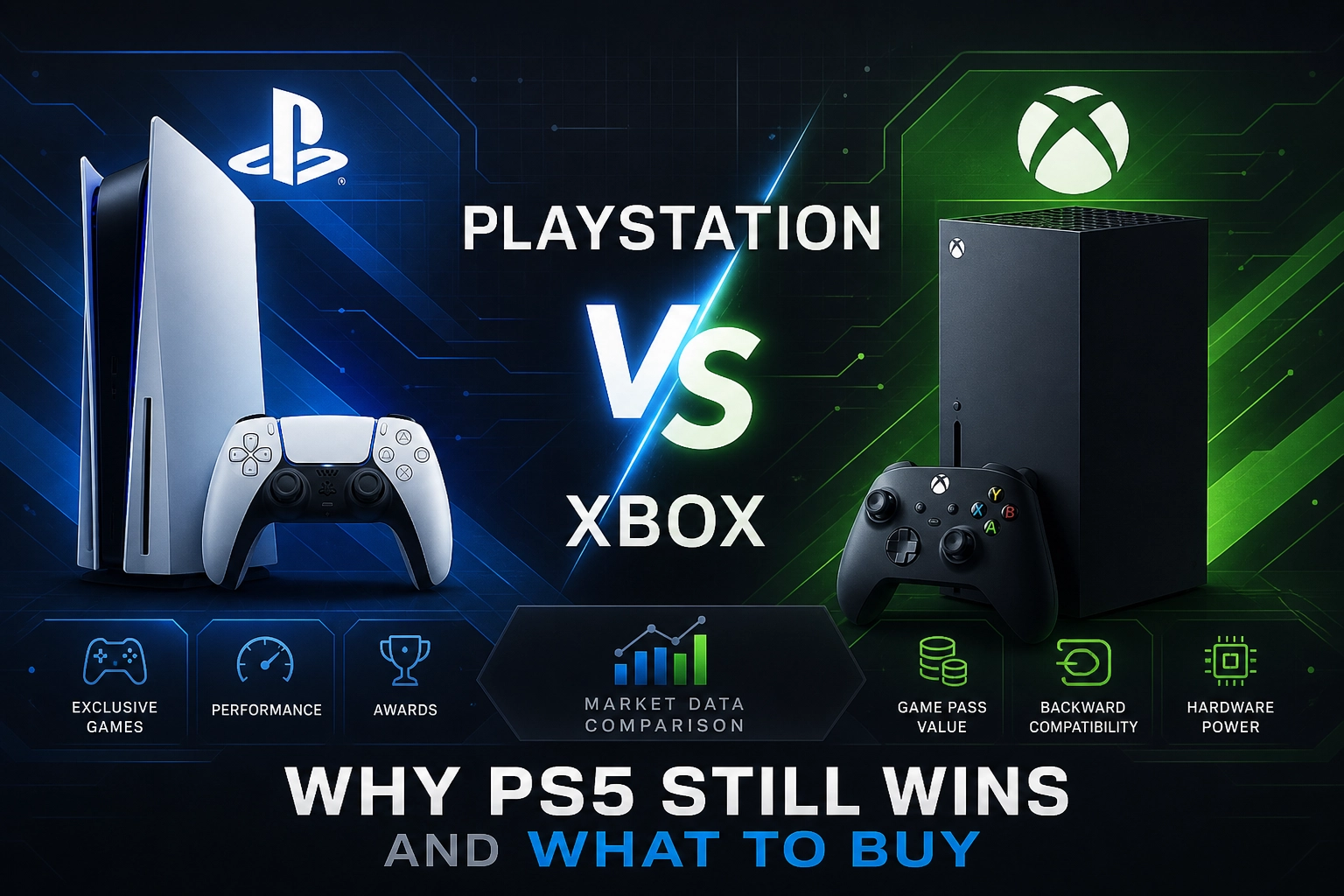
If you are choosing between a PS5 and an Xbox Series X|S in 2026, the market has already cast a decisive vote. As of July 2026, VGChartz estimates put PS5 lifetime sales at 94.09 million units against 35.21 million for Xbox Series X|S, a lead of 58.26 million. That is roughly a three-to-one advantage, and it is still widening. In June 2026, PS5 captured 72.7% of the two platforms' combined sales, up 2.5 points year over year. Xbox's 86% June sales bounce was real in isolation, but it came off a weak 2025 base while the wider market fell. This post cuts through the noise. We will examine the install base, the widening gap, regional strength, price parity, Microsoft's subscription pivot, exclusives, backward compatibility and digital library lock-in, PS Plus vs Game Pass, digital versus disc models, and where to save on keys, gift cards, and memberships. By the end, you will have a plain decision framework for your next purchase and a clear sense of how the gap should inform it.
What the Numbers Actually Say: PS5 vs Xbox Install Base in 2026
Start with the headline. VGChartz estimates put PS5 lifetime sales at 94.09 million units as of July 2026, against 35.21 million for Xbox Series X|S, a lead of 58.26 million consoles (July 2026 sales comparison). These are retail-sampling estimates, not audited Sony or Microsoft disclosures, so read them as directionally correct rather than official.
A second snapshot tells the same story. June 2026 data places PS5 at roughly 91.04 million units against roughly 34.43 million for Xbox Series X|S combined, close to three PS5s sold for every Xbox (June 2026 comparison).
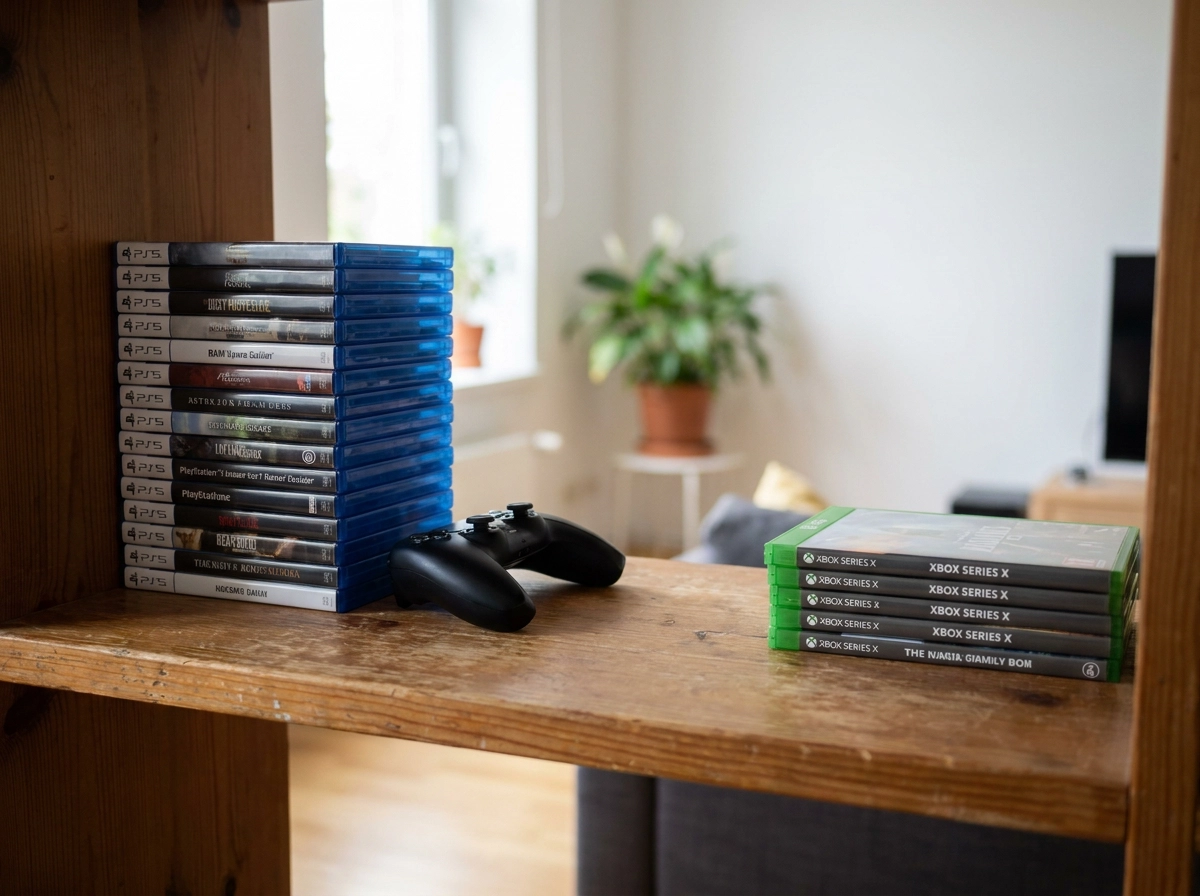
Share of combined sales kills the "it is close" assumption. PS5 held 72.7% of the two platforms' combined sales in June 2026, up 2.5 percentage points year over year.
Momentum matters more than any single snapshot. In July 2026 alone PS5 added 784,102 units while Xbox added 115,442, meaning the gap is still widening rather than merely holding.
Why should a sales chart influence your purchase? Install base shapes what you actually get. A bigger base means fuller multiplayer lobbies and faster matchmaking, particularly in older titles. It also pulls third-party support and marketing priority towards the leading platform, deepens the pre-owned and digital catalogue, and keeps resale and trade-in interest stronger for longer. That is the practical link between a sales figure and your money.
So the direction of travel is clear. The next question is why this gap keeps widening instead of closing.
Why the Gap Keeps Widening Instead of Closing
The snapshot matters less than the direction of travel. Over the twelve months to June 2026, PS5 outsold Xbox by 13.53 million units, and PS5's lead grew by another 499,658 units in June 2026 alone (trailing twelve month trend data). Worldwide year-to-date sales confirm this is not a monthly quirk: January to July 2026 saw 4.66 million PS5 sales against 0.98 million Xbox Series consoles. Strip out any single month and the annual picture still shows roughly five PlayStation consoles sold for every Xbox.
The financials explain why. Sony shipped 1.6 million PS5 units in the April to June 2026 quarter (Sony's PlayStation earnings), while Microsoft's Xbox hardware revenue fell 29% across fiscal 2026. One company is still investing in box sales; the other is not.
That matters because of the flywheel. A larger install base pulls in more third-party investment and bigger online populations, which makes the platform more attractive to the next buyer, which grows the base again. The loop compounds, and it is why a lead this size rarely closes quickly.
Be fair to Xbox, though. A widening hardware gap does not automatically mean a worse customer proposition. Microsoft is deliberately competing on subscriptions and ecosystem access rather than console units, so judge that strategy on its own terms rather than on the sales chart alone.
The June 2026 Xbox Bounce Was a Base Effect, Not a Comeback
You may have seen the headline: Circana's US retail tracking put Xbox Series X|S unit sales up 86% in June 2026, with dollar spending more than doubling. Read alone, it looks like a comeback.
It is not. The comparison was against a very weak June 2025, and a percentage rise measured off a tiny base inflates mechanically. Unit and revenue gains are also not interchangeable, because average Xbox selling prices rose in the same period. Circana's underlying reports sit behind a paywall, so almost all June 2026 Xbox coverage is second-hand reporting derived from it. Treat it accordingly.
Then look at the market around it. Total US video game spending fell 21% year over year to $4.49bn, with hardware spending down 62%, PS5 down 19% and Nintendo Switch 2 down 79%. Xbox grew share inside a shrinking month, not a growing one.
The forward view agrees. Analysts still expect Xbox shipments to fall 22% this year, and subscriptions were the only category still growing in the June data.
So here is the buyer's lesson. A single-month percentage without a base period, market direction and pricing context is not a purchasing signal. When you are spending hundreds of pounds on hardware, judge platforms on trailing-year and lifetime trend lines.
The Regional Picture: Where PlayStation's Lead Is Absolute
Regional splits matter more than any global total, because matchmaking pools, shop shelves and support are all local.
Through July 2026, estimates put the Americas at 36.69 million PS5 units against 21.91 million Xbox Series consoles. That is the closest region and PS5 still leads by roughly 1.7 to 1. Europe is far more lopsided: 33.26 million against 8.76 million, the widest proportional gap outside Japan and the figure that matters most to UK and European buyers deciding where their online friends will actually be. Japan is barely a contest, at 7.67 million against 0.71 million lifetime, with just 20,000 Xbox Series consoles sold between January and July 2026 against 0.34 million PS5s. Treat these as retail-sampling estimates rather than official disclosures, but not the direction: PS5 sales were up year on year in Japan in July 2026.
Practically, a larger local install base means fuller lobbies for multiplayer, stronger accessory and repair support on the high street, more physical stock in shops, and a better than even chance a friend or family member already owns the same machine.
One caveat worth your money: official hardware and subscription pricing varies by region, and digital storefronts often price differently from high street retail. Check both before committing, because a region-appropriate membership or key frequently undercuts storefront rates.
Price Parity Did Not Change the Scoreboard
The regional splits explain where PlayStation's lead is deepest, but price is the factor buyers assume will change the equation. It did not. In June 2026, the standard disc PS5 and the Xbox Series X both sat at exactly $649.99 in the US, up from a $499.99 launch price in 2020. Identical stickers, same month, no shift in momentum: PS5's share of the two platforms' combined sales still rose 2.5 percentage points year on year.
That single data point dismantles the idea that console buyers simply chase the cheapest box. If price decided the race, parity would have narrowed the gap. Instead, buyers kept choosing PlayStation on games, friends and ecosystem.
The premium tier tells a similar story. PS5 Pro is priced at $899, while Xbox hardware pricing has climbed from $499.99 to $799.99, with a further confirmed increase landing 1 August 2026. Any "which console is cheaper" comparison must therefore carry an "as of" date. Xbox pricing has moved repeatedly; a comparison written in a different month can already be wrong.
Reframe the maths before you buy. Hardware is a one-off cost. Games, subscriptions and accessories are the recurring cost, and over three to five years they usually dwarf the console itself. A small saving at checkout is trivial next to a year of subscription or ten full-price games.
That raises the real question. If not on price, where is Microsoft competing?
Microsoft's Pivot: Hardware Units Out, Subscriptions In
Hardware price is one variable. Strategy is the bigger one, and Microsoft has quietly rewritten its own.
Xbox hardware revenue fell 29% across fiscal 2026, and analysts expect shipments to drop a further 22% this year. That is not a rounding error, but it is also not the full story. Microsoft is deliberately shifting its success metrics away from boxes sold and towards ecosystem and subscription revenue, which decouples its performance from the console sales chart most coverage fixates on.
The supporting signal is unambiguous. In the June 2026 data, subscriptions were the only category still growing, exactly what a subscription-first strategy would predict. Content and services revenue, which bundles game sales, downloadable content, advertising and Game Pass, still fell 10% year over year in the quarter, so this is a transition in progress rather than a completed one.
Treat the pivot as a strategic choice, not simply decline. Publishing first-party titles across multiple platforms and pushing Game Pass can be commercially rational even while box sales slide, and that calculation matters if you are weighing long-term platform support.
For buyers, that cuts both ways. A subscription-led Xbox is genuinely attractive if you value a large rotating library at a low monthly entry cost, and it lowers the price of trying big releases. The trade-off is reduced predictability: hardware roadmap commitments and the exclusivity pipeline become harder to forecast, which makes Game Pass itself, rather than the console, the real product to evaluate.
Exclusives and First-Party Games: The Real Buying Driver
That subscription-first strategy makes sense once you accept that the sales gap is downstream of software, not the other way around. Sony's single-player first-party line-up is the clearest reason a buyer picks PlayStation, and it is what makes the install base compound: a must-play exclusive sells a console, that console sale attracts the next exclusive's audience, and the loop repeats.
Respect the Xbox counter-model, though. Day-one Game Pass releases and multi-platform publishing lower the cost of entry to major titles, but they also remove the reason to buy the box specifically for exclusives. That is a fair trade, not a failure.
The practical asymmetry matters more than the politics. A long-form narrative exclusive is a purchase trigger; a subscription value proposition is a retention tool. One brings people in, the other keeps them. Circana's Q1 2026 survey found 41% of US console gamers named exclusive games as their top reason for playing on a console, which supports that asymmetry.
So apply a blunt rule: choose the console whose games you would already pay full price for today, not the one with the better announced roadmap. Announcements slip; you cannot play a teaser.
And if you only finish a handful of big titles a year, buying them outright at a discount is usually cheaper than any subscription. That is where digital game keys earn their place, letting you own the titles you actually want rather than renting a library you will never finish.
Backward Compatibility and Digital Library Lock-In
If games decide the platform, your existing library decides whether switching is even affordable. PS5 plays the large majority of the PS4 library, and PS Plus tiers add a catalogue of older classics, so upgrading within PlayStation carries much of your collection forward. Xbox counters strongly here: Series X|S backward compatibility spans multiple generations, and Smart Delivery upgrades many older titles to their best available version. For long-time Xbox owners, that is a genuine advantage.
The cost no sales chart shows is the digital library itself. Purchases do not transfer between PlayStation and Xbox. A 100 game account can represent hundreds of pounds of value that evaporates the moment you change brands, because no mechanism carries those licences across.
The softer lock-ins add up too: trophies and achievements, friends lists, cloud saves, captured clips and message history. Individually trivial, collectively significant, they make a fresh account feel like starting over.
The rule of thumb is simple. If you hold a substantial library on one account, the switching cost usually outweighs a one-off hardware price difference. Upgrade within your ecosystem unless the other side's catalogue genuinely wins you over.
Audit that library before you spend, then look at what each side charges you every month, because that recurring cost is where the next real difference sits.
PS Plus vs Game Pass: Which Subscription Fits Your Money
Those soft lock-ins extend naturally to subscriptions, which is where both platforms now compete hardest.
Game Pass: the value argument. Xbox's strongest case is a broad rotating library that includes first-party titles on release day, with PC and cloud tiers widening access beyond the console itself. If your priority is a low monthly entry fee for a large, changing catalogue, this remains the clearest single reason to own an Xbox.
PS Plus: tier-dependent. Sony's service spans multiple levels, from online play essentials at the entry point up to a larger game catalogue and a classics collection. The right tier depends on your habits: online multiplayer only, a library only, or both.
Do not expect subscriber statistics to settle the argument. Reliable public counts are not available in the current dataset, so judge each service on what it delivers per month rather than quoted totals.
The market signal is clearer than the counts. Subscriptions were the only category still growing in the June 2026 data, confirming hardware price is no longer the battleground. Recurring value is.
The saving tactic that works on both. Annual membership codes typically cost less per month than paying monthly. Buy a discounted membership term up front, or stack a discounted gift card against your subscription, and you cut the recurring cost without changing platform. It is the least disruptive saving in gaming.
Whichever side you pick, the next decision is physical or digital, and that one shapes your spend for years.
Digital-Only or Disc: Which Model Should You Actually Buy
Subscriptions shape your recurring cost, but the hardware model you pick shapes what you pay for games themselves.
Both platform families split the same way. The PS5 Digital Edition and Xbox Series S ship without a disc drive, while the standard PS5 and Xbox Series X include one. That single omission changes your long-term spend more than any subscription tier.
Physical Still Pays
Discs hold resale value, can be lent or traded, and often fall in price at retail faster than digital storefronts. If you finish games quickly or buy heavily at launch, recouping part of the cost suits you. Digital copies cannot be resold at all.
Digital Still Wins On Convenience
Storefront sales, subscription catalogues and discounted digital keys frequently undercut disc pricing, with instant codes and no stock dependency.
Storage is the hidden cost. A digital-first library fills the SSD quickly, and the Series S has the smallest drive of the four, so budget for expanded storage or manage installs ruthlessly.
The cheaper box is not automatically cheaper to own. Disc-free hardware locks every future purchase to storefront pricing, where digital keys are your main workaround. Upfront savings rarely survive five years of buying games.
Next: where to cut those recurring costs.
Where to Save: Digital Keys, Gift Cards and Memberships
Whichever model you chose, the recurring cost is where the real saving sits. ElectronicFirst operates as that saving layer: it stocks PS Plus memberships, Game Pass subscriptions, platform gift cards and digital game keys for both ecosystems.
Digital delivery is central to the value. An instantly delivered code carries no shipping charge and bypasses regional retail markups, so the price you pay is often visibly below the storefront or high street equivalent.
A tactic that works on either platform: buy discounted platform credit or gift cards, then use them to fund your next full price purchase. Twenty pounds of credit bought for less effectively cuts the cost of the game you were already going to buy.
The biggest win is subscription stacking. If you know you will keep PS Plus or Game Pass for twelve months, a longer membership term bought up front usually beats paying month to month, and buying that term at a discounted rate compounds the saving.
Stay decision-matched. A PS Plus code will not activate an Xbox account, a Game Pass code will not work on PlayStation, and codes are generally region-locked. Buy for the console you actually own, and check the region before checkout.
Which Should You Buy Next? A Plain Decision Framework
The savings side is sorted. Now the decision itself, and it takes three tests rather than a sales chart.
Choose PS5 if you want the largest online player pools, the strongest single-player first-party line-up, solid PS4 backward compatibility, and a disc drive for resale value. With roughly three PS5s sold for every Xbox, friends, matchmaking and third-party support are most likely to live here.
Choose Xbox if Game Pass day-one value is your priority, you hold a deep existing Xbox library, or you want the cheapest modern entry point in the Series S. Just accept that hardware pricing has climbed and a further increase lands 1 August 2026, so timing matters.
Test one: the two-question test. How many games do you already own on each account? How many upcoming titles would you genuinely pay full price for? Whichever side scores higher is usually the right answer, regardless of what the sales charts say.
Test two: the three-year budget. Add up hardware, one or two subscriptions, and roughly ten games. This exposes the cases where a cheaper console becomes the more expensive platform, because storefront pricing never comes down.
The tiebreaker. PlayStation's lead is real and still widening, but treat it as confirmation, not a verdict. Let it reassure you about online populations and third-party support. Do not let it override the games you actually want to play.
The Takeaway: Let the Gap Inform Your Next Purchase
The gap is a signal, not a scoreboard. Everything above points to the same conclusion, and it fits neatly into the two-question test you just ran.
PS5 leads Xbox Series X|S by roughly 3 to 1 on lifetime units and is still widening that lead, holding 72.7% of the two platforms' combined June 2026 sales. Worth noting these are VGChartz estimates, so read them as direction, not audited fact.
The correction matters just as much. Xbox's 86% June 2026 unit rise came off a weak June 2025 base while the wider market shrank 21% that month. It was not a comeback.
The money lesson is the one to carry forward. Price parity at $649.99 did not close the gap, which tells you games, subscriptions and ecosystem lock-in drive the decision, not the sticker price. Those figures are US list prices; UK street pricing moves separately, so check it on the day.
Three steps before you spend:
Audit your digital library. A large existing account is expensive to walk away from.
Price out three years of total cost. Hardware, at least one subscription, roughly ten games.
Buy at a discount. Memberships and digital keys undercut storefront rates, and longer terms beat monthly.
So here is the direct recommendation. Pick the platform whose games you want now, confirm the online population suits you, then trim the recurring costs with competitively priced PS Plus or Game Pass memberships and digital keys. Match every code to the console you actually own, because memberships and keys do not transfer between platforms, accounts or regions.
Conclusion
The evidence points one way: PS5 still holds a commanding lead, roughly 3 to 1 on lifetime units and 72.7% of combined June 2026 sales. Xbox's June bounce was a base effect, not a comeback, and price parity did not change the scoreboard. Games, subscriptions, and ecosystem lock-in decide the winner for you.
Before you buy, audit your digital library, price three years of total cost, and hunt discounts on memberships and digital keys. Pick the platform with the games you want now, confirm its online population suits you, then trim recurring costs. Match every code to the console, account, and region you actually use.
Use this framework to spend wisely and play more. The right console is the one you will enjoy today, not the one that wins a chart.