


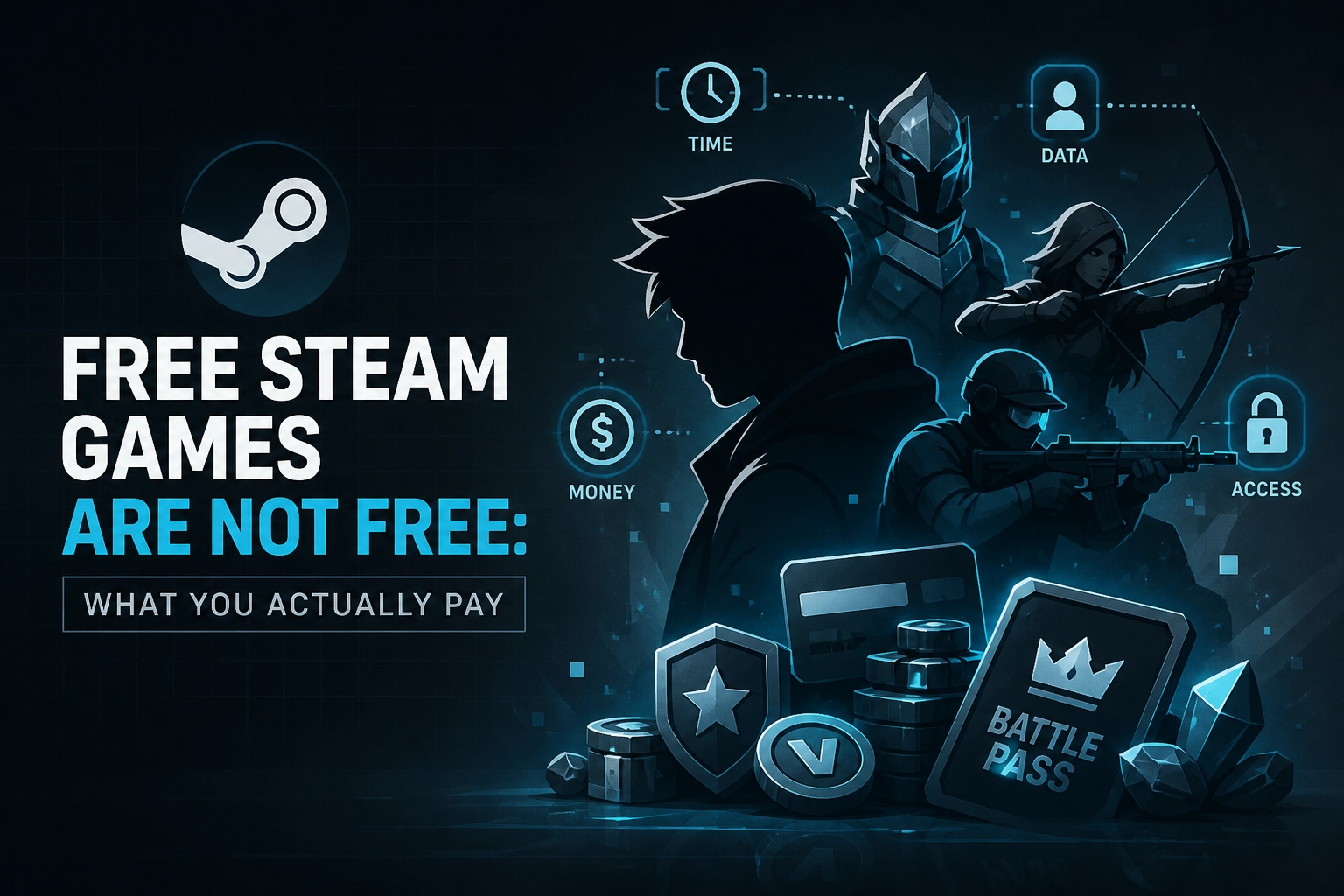
You see a price tag of zero and hit download. A few weeks later, you've spent more on that "free" game than you would have on a full-priced AAA title. That's not a mistake on your part. It's exactly how the free-to-play model is designed to work. Free Steam games are everywhere, and they're brilliant fun, but the shelf where nothing has a price is often where players end up spending the most without noticing.
You install it for nothing, you play for a fortnight, and then the season pass drops, the shop refreshes, and the coins you bought are already sitting in your wallet. That's the moment the free game starts charging you. Whether you're a parent watching the card statement or a player watching your own balance, knowing which asks cost what is most of the battle.
The Free Shelf Is Where the Money Goes
A free game has no price tag, which means it has no natural spending ceiling. That is the honest version of the pitch: free describes the download, not the hobby, and a buy-once full-price release can end up the cheaper option.
Steam's "Free to Play" label describes the entry price only and says nothing about what the rest of the game costs, so treat it as a starting point rather than a verdict. Browse the free games on Steam knowing that any title with a rotating shop or a paid track expects you to spend eventually.
Three add-on types turn a download into a running cost:
Battle passes: a paid track of rewards tied to a fixed period called a season.
In-game currency packs: premium currency is the separate coin or point system a game sells for real money, then prices items in.
Paid DLC: downloadable content, meaning extra maps, story or modes sold separately from the base game, even when the base game cost nothing.
Learn those three and the rest of this piece will make sense.
Battle Passes: A Subscription You Buy One Season at a Time
If the free shelf is the shop window, the battle pass is the recurring direct debit behind it. Mechanically, a pass runs for a set season. It usually has a free track and a paid premium track, and you unlock rewards by playing during that window. When the season ends, the pass expires. Anything you did not claim by then is gone, not banked for later.
That deadline is where the value trap sits. Battle passes reward steady playtime. Buy one for a game you dip into every few weeks and you are effectively paying for rewards you will never reach. The pass only pays off if you finish it.
The stacking problem makes this worse. Each free title runs its own season on its own calendar. Play three or four and you are juggling separate deadlines, separate premiums, and separate asks. Each one feels small next to a full-price game, but they land at different times and add up faster than any single purchase would suggest. If you also follow paid shooters, our breakdown of whether Call of Duty: Modern Warfare 4 is coming shows the same seasonal rhythm.
And the pass is rarely the only ask. Most sit beside currency packs, cosmetic bundles and limited events. Treat the pass as the entry ticket, not the full spend. The next piece of the budget is the currency you need to use it.
Currency Packs and the Leftover Balance Problem
Battle passes are only one line on the bill. The next is the currency you buy to spend inside the game. Premium coins or gems exist partly to decouple the number on an item from the amount of real money leaving your account. You see 1,000 coins, not a clear dollar or pound price, and that makes comparing costs across different games much harder.
The CFPB used a simple illustration in its 2024 consumer advisory, and it is worth treating as an illustration rather than a market statistic: an item costs 1,000 coins, but coins are sold in bundles of 700 or 1,600. You buy a pack, buy the item, and still have coins left over.
That leftover balance is the trap. In most games it cannot be converted back into real money, so it sits in your account and quietly nudges you toward another pack to make the first one feel worthwhile. The CFPB's 2024 report on video game marketplaces also flagged that exchange rates between real money and in-game currency can be confusing and inconsistent from game to game (CFPB report on video game marketplace risks). Some free titles run more than one currency, so pricing a single item can mean doing sums across several balances before you know the real cost.
DLC, Expansions and What a Free Game Still Sells

That leftover balance is exactly the nudge that sends people toward cosmetic DLC. When your coins are already sitting there, a skin bundle stops looking like real money.
Cosmetic DLC: Skins, Emotes and Bundles
Cosmetic DLC changes how a game looks, not what you can play: skins, emotes, weapon wraps, sprays and the bundles that package them together. These are frequently priced in premium currency rather than cash, so treat the bundle price as a puzzle to solve with wallet maths, not a price tag.
Content DLC: Expansions and Extra Maps
Content DLC is the bigger commitment: expansions, additional story, extra maps or modes. Unlike a battle pass, it is usually a fixed one-off purchase, and it often gates content the free tier advertises but does not fully include. Stack a couple of expansions and the total creeps toward what a paid game would have set you back.
Launch window bundles and founder style packs are worth extra caution. They tend to be limited, and timed offers push you to buy before you know whether the game will hold your attention past the first month. Read the store page for the current price and exactly what is included, then decide.
That question of what can be paid for from a balance is the next thing worth getting straight.
Can You Buy Add-Ons With a Gift Card or Code?
Once you've weighed up DLC, the next question is practical: can you pay for any of it with a gift card or code? A gift card or digital code generally tops up your platform wallet, and where purchases are eligible they draw from that balance rather than a stored card. That can work as a firm cap: no balance, no purchase. The US consumer watchdog, the CFPB, made a similar suggestion in its 2024 advisory: consider a gift card or another method that blocks surprise overcharging.
The limits matter, though. Whether a specific add-on, pass or currency pack can be bought from wallet funds depends on the platform and the game's own store. Check the store page before you commit, and don't assume every purchase route is eligible.
If you need a top-up, ElectronicFirst is somewhere to pick up gaming gift cards and digital codes used to fund platform wallets, such as a PlayStation Store card. If you're weighing a subscription instead, a Game Pass Ultimate breakdown covers the recurring cost.
One caveat: topping up a wallet isn't the same as locking a payment method. For a firm limit, remove stored payment details too. The CFPB flagged that games often keep payment information on file.
What Regulators Have Said About In-Game Spending
Removing stored payment details is one defence. The other is knowing what watchdogs have already flagged, because it tells you what to watch for next. The US Consumer Financial Protection Bureau published a consumer advisory in August 2024 on in-game currency and purchases. It raised three concerns: exchange rates that are confusing and inconsistent between games, payment details stored inside games with few visible controls, and limited recourse when players lose money. On loot boxes, the CFPB compared them to casino-style gambling, pointing to flashy animations around rare items as a nudge to spend more. It noted Belgium banned loot box sales in 2018, Austria banned certain boxes, and South Korea requires probability disclosure.
The recourse point is the one to sit with. According to the advisory, publishers generally claim no duty to compensate players for losses. Refunds are rare after a game shuts down or an unauthorised transaction goes through.
One caveat: the advisory and the main summary of it both date to 2024. We found no later regulatory action in the research for this piece, so treat it as the most recent guidance we could verify, not a guaranteed current position. The UK picture on loot boxes and in-game currency was not covered by that research, so we have left it out rather than guess.

How to Budget for a Game With No Price Tag
The good news is that a spending cap is easy to build once you stop thinking item by item. Budget per game, or per platform per month, instead. Individual bundles are priced to feel small, and the total only becomes visible when you add up a whole month. If you are still weighing up which console to budget around, our comparison of PlayStation vs Xbox is worth a read first.
Before you install anything, read the store page. What does the free tier actually include, and what sits behind a paywall? Note any paid DLC in particular, so you know the shape of a game's monetization before you commit time to it.
Keep a running note of unspent currency balances across your games. A leftover balance is money you have already spent, and a small leftover is often what nudges you into a pack you did not plan for. The same logic applies to cashing in a Roblox gift card: know what the card is worth before you convert it.
If a younger player shares the account, check the parental payment controls. The CFPB's own suggestions include considering titles without in-game purchases where those controls are not there.
Finally, treat every purchase as final. Refund options for in-game content are usually narrow or nonexistent, so ask whether you will genuinely finish the season before you pay for it.
The Real Price of a Free Game
Budgeting helps, but it does not change the underlying maths. Free is an entry price, not a running cost, and the add-ons decide which one you actually pay. Two players can download the same title and end up spending wildly different amounts, purely because one buys every pass on day one and the other waits to see what they will actually play.
Term length on Game Pass Ultimate changes the real monthly cost, so check that alongside your in-game spending.
Conclusion
A battle pass costs a fixed fee per season, currency packs cost whatever the bundle size charges you, and DLC is usually a one-off price that varies by expansion.
Pick one free game you're already playing and read its shop page today, before the next season starts selling you something else.