


You know the feeling. A game you've been hyped about for months finally launches, you hit buy without thinking, and then three weeks later it's 20% off in a random midweek sale. Suddenly that day-one purchase stings a little. The truth is, the biggest savings on new releases rarely come from launch-week promos or preorder bonuses. They come from understanding how a game's price actually decays over its first year. That's a timing decision, not a release-date question.
In this post, we're going to walk through the typical price arc of a new release, from the preorder window through launch-week full price, the first real discount, and eventually the seasonal floor. You'll learn how to read a price curve yourself, get a simple framework for deciding whether to buy now or wait a quarter for a key, and see how to time a key purchase to the bottom of the curve. Fair warning: hard data on launch-window price decay is thin on the ground, and I'll flag where the evidence needs sourcing before anyone treats this framework as gospel. But the logic itself is worth understanding, because it changes how you spend. Let's dig in.
Why the Best Deal Is Rarely a Launch-Week Deal
Launch-week promotions tend to focus on extras rather than the price itself. You might get a preorder bonus, a cosmetic pack, a few days of early access or a little store credit, and the headline price is usually close to what it was before.
That makes sense. People willing to pay full price buy in the first weeks, so there is no reason to discount while they are shopping. Cuts start once that group is served and the seller wants buyers who were waiting for a signal.
That waiting group is bigger than it looks. Plenty of people play games every month without buying the newest release on day one.
One caveat: this is a general pattern, not a fixed schedule. A small indie and a blockbuster will not follow the same rhythm. Football Manager 27, for example, opens with a five-day free play window before its 10 November launch, which is a different shape of launch entirely. Bear it in mind when scanning popular deals.
The Shape of the Curve: Four Phases of a New Release's Price
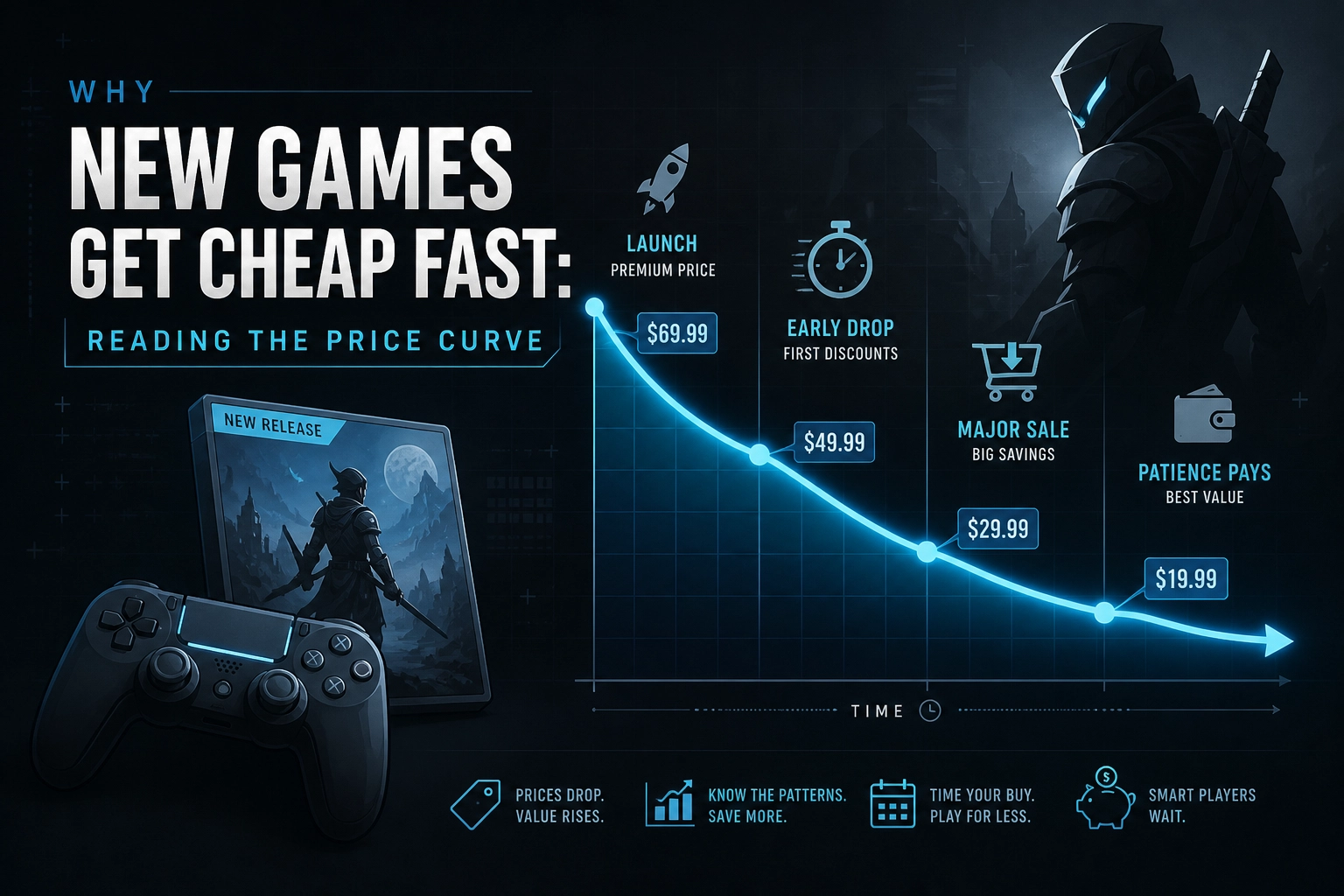
So if launch week isn't where the savings live, where are they? Think of a new release as moving through four phases: the preorder window, launch at full price, the first real discount, and the seasonal floor. Treat it as a way to think about timing, not a calendar to memorise.
It behaves like a curve rather than a cliff because prices tend to step down at decision points, whether that is once the launch buyers have bought or when a major sale event arrives. They don't slide smoothly week by week.
Valve's Tom Giardino has noted there is no single correct discounting strategy, which is why the model's value is knowing when to start watching a price, not predicting a date. Once you can spot which phase a game is in, whether to buy now becomes much easier to answer without second-guessing.
Two things bend it: how the game was received at launch, and how long its multiplayer or live-service audience holds. Both are checkable before you decide.
Phase One: The Preorder Window
The preorder window is where the least financial value usually sits. What you are mostly buying is certainty: day-one access plus cosmetic or in-game extras, and only occasionally a modest saving on a digital edition. It is rarely a meaningful price cut. Publishers tend to keep preorder incentives modest, so nobody who commits early feels punished a week later.
The trade-off is honest. You lock in launch day and any bonus content, but you commit before reviews land, before performance reports appear and before launch-window patches arrive. If you do preorder, treat the bonus as the only thing you are genuinely getting, assume the price will fall later, and only commit for games you were always going to play at launch. Reading the next Call of Duty release details is a useful reminder that hype is not a discount.
There is an edge case: occasionally a preorder or launch-window price turns out to be the best a game sees for a while. That is exactly why checking price history before ordering matters, and why launch week deserves its own decision.
Phase Two: Launch Week at Full Price
Once launch day arrives, the preorder window closes and you are generally paying the full standard price. Retailer bundles and storefront promotions tend to change what is packaged with the game, not the base cost.
Waiting a single week usually does not pay off.
What does full price buy? The busiest lobbies, day-one conversation and no spoiler risk. That is real value, just not financial.
Launch pricing makes sense for multiplayer and live-service games where an early start is part of the product. It also makes sense when later key or physical availability is uncertain.
Paying full price is a choice about experience rather than value. Make it deliberately, not by default. If you would rather wait, a subscription can bridge the gap, and our guide to Xbox Game Pass Ultimate: 1, 3 or 12 Months to Buy? helps you choose a term.
Phase Three: The First Real Discount
The first real discount is the moment the equation changes, and it tends to arrive a while after launch rather than on a fixed timetable.
Real means a cut that visibly changes what you pay. Ignore bundles, cosmetic packs and tiny store credits. Judge by the number, not the badge on the store page.
Find the moment yourself: keep the game on a wishlist and check its price history, so you can see whether this cut is the deepest so far.
Don't treat the first cut as the floor. An early cut is usually not the last one. Treat it as a signal to start watching, not a finish line.
So is it good enough? Weigh it against your backlog, how much you want to play right now, and whether post-launch patches have changed how the game stands. Clear those and buy. Otherwise, keep watching.
Phase Four: The Seasonal Floor
After that first cut, the price keeps easing, and further down sits the seasonal floor, where the big sale events matter more than any launch promo. These windows are where the biggest cuts across a whole catalogue tend to land, and relatively recent releases can get swept in too. For a lot of titles, this is the price most players eventually pay, which is why patient buyers usually win on pure cost.
The catch is honest: the deepest cuts mean the longest wait, and by then the conversation has usually moved on. You save money, but you trade away being part of the moment. Plan around it by keeping a wishlist running all year and setting a target price you would happily pay. Buy when the curve crosses that number rather than chasing the absolute lowest one. One regional note: pricing and sale timing vary by storefront and region, so UK and US players can see different discounts. Compare in your own region, and if you are still choosing hardware, this PlayStation vs Xbox comparison helps frame platform costs.
How to Read a Price Curve Yourself
Once you've clocked the seasonal floor, stop chasing it and set up a system that watches for you. Start with price history, which is how you tell whether the current price is genuinely cheap for that game or just cheap next to launch.
Reviews and patches belong in your notes too. A rough launch that has since been fixed can be the better deal, not just the cheaper one.
Drop deadline thinking. No sale is unmissable and no schedule needs memorising. A standing wishlist does the watching while you get on with something else. If you're weighing a subscription while you wait, our guide to whether Xbox Game Pass Ultimate is still worth it covers what it actually costs.
Buy Now or Wait a Quarter? A Simple Decision Framework
Start with three questions: do you want to play it this month, will you still want it in three months, and does today's price fit what you would pay for any game? Two clear yeses is usually a buy.
Then weigh the social cost of waiting. Lobbies thin out, spoilers spread and group chats move on, so waiting is cheapest for single-player games you can play at your own pace. Accept the trade: launch gets you the busiest version and the most discussion; waiting gets you the same game for less and usually more polished. When you would rather own the game outright, buy once your target price is met.
Timing a Key Purchase to the Bottom of the Curve
When a game has settled into a discount pattern, buying a digital key lets you move the moment the price reaches your target rather than waiting for a storefront sale event. Digital delivery also means there is nothing to wait for once you have decided.

ElectronicFirst sells digital game keys, gift cards and subscriptions such as Game Pass and PS Plus across major platforms, with delivery handled digitally. If you ever buy in volume for a group or resell, there is a wholesale and bulk digital keys for resellers route too.
Keep the question on timing, not hype: is the price at the point you chose to buy, not whether the game is currently popular? Before you commit, check region and platform. Prices can differ between the two, so match what you buy to the account region and platform you actually play on.
The retailer or key store is the last step in the process. Your decision rule is the part that actually saves you money.
Your Rule for the Next Big Release

So that is the whole toolkit on the table: a rule, written down, executed without drama.
Before launch, pick your target price and wishlist the game. Then buy when the price gets there, not when a trailer, a countdown timer or a "limited time" banner tells you it is time.
Buy at launch only when the experience is the point. Multiplayer and live-service releases, or games you will genuinely play with mates in week one, earn the full price. Very little else does.
Everything else? Wait for the first real discount or the seasonal floor, and check price history first so you know which of the two you are looking at.
When your target is met, buy for your platform and region, then stop watching. No refreshing trackers, no regret when it drops again. That is the whole trick: know the phases so the decision stays yours.
Conclusion
Your next step: pick the next big release you actually want, wishlist it, and write your target price down today. When that price comes around, buy for your platform and region, with ElectronicFirst as the last stop in the process, not the first.